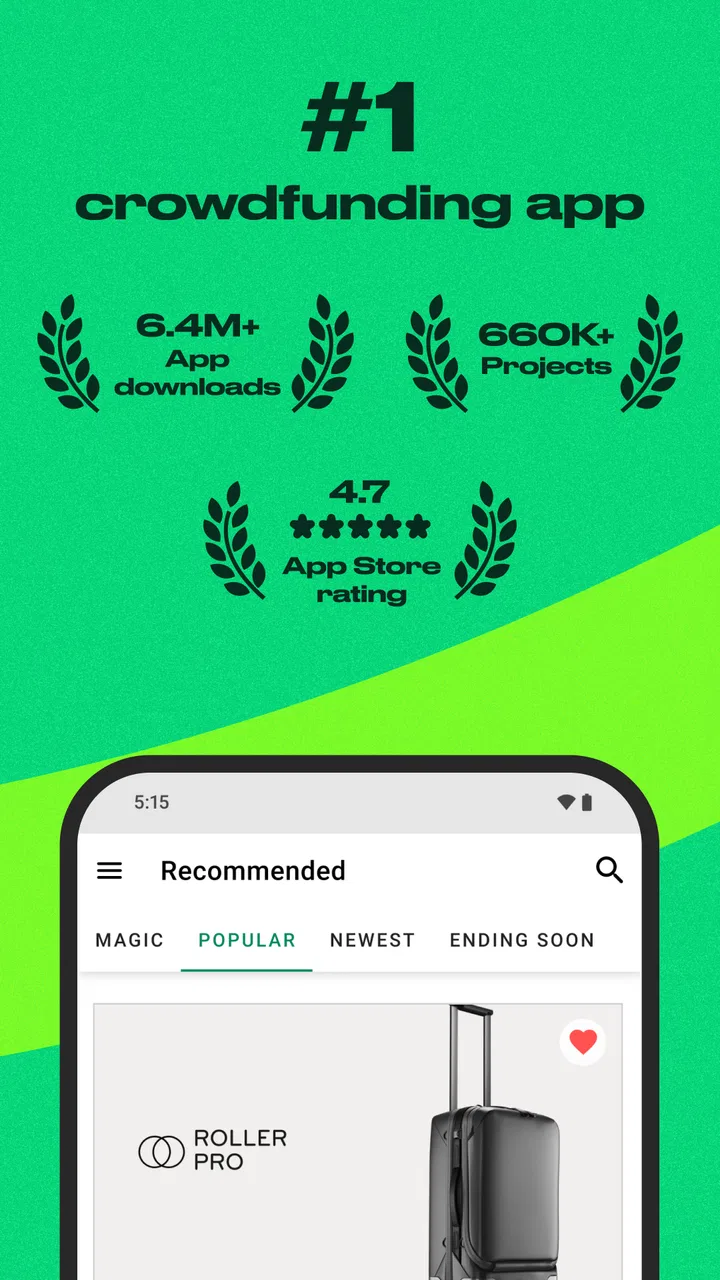
Kickstarter
- 4.7
- Rating
- 5.00M
- Installs
- Free
- Price

 Analysis by App-foxy
I use Kickstarter less like a shopping app and more like a window into unfinished ideas. It is a social app from Kickstarter PBC where creators present projects and people decide which ones deserve support. The basic action is simple: browse a project, understand what the creator wants to make, choose a reward level, and follow the campaign as it develops. In practice, the important decision is not whether the app looks attractive, but whether you are comfortable supporting something before it exists.
That distinction makes it very different from an ordinary store. When I buy a finished product, I expect a clear delivery process and a known result. With Kickstarter, I am joining the early stage of a creative project. Sometimes that feels exciting and personal; sometimes it requires patience and a willingness to accept uncertainty. If you enjoy discovering books, games, films, design objects, comics, or other creative work before they reach a wider audience, this app gives that process a focused place to happen.
How I Decide Whether Kickstarter Is Worth Using
The first thing I look at is not the reward image. I begin with the creator’s explanation of the idea, because a polished presentation can make an uncertain project feel more finished than it really is. I want to know what is being made, why the creator needs support, and what the reward actually includes. The app is useful here because it puts the project story, funding request, reward choices, and updates together instead of scattering them across social networks and separate shopping pages.
You May Also Like

 Blood Strike: 2.5 Anniversary
Blood Strike’s Loadouts Turn Every Drop Into a Tactical Gamble
A close look at Blood Strike’s custom loadouts: how fast access to signature weapons reshapes its battle royale rhythm, rewards preparation, and narrows the gap between fights.

 Pandora - Music & Podcasts
Pandora’s Music Is Easy to Start, but Harder to Recover
Pandora’s strength is its low-effort path from a seed to a station. Its weak spot is how much confidence it asks you to place in connection, setup, and quiet recovery.

 8 Ball Pool
 Is Built on Rivalries, Rematches, and Routine
A close look at the rivalries, rematches, shared routines, and unanswered safety questions that turn a quick pool match into a persistent mobile community.

 Samsung Music
’s Quiet Strength Is Playing What You Already Own
Its reach comes less from spectacle than from dependable access to a personal library. That simplicity is both the app’s strongest retention engine and its ceiling.

 AccuWeather: Weather Radar
AccuWeather Review: A Quick, Clear Forecast for Everyday Decisions
For everyday plans, the best forecast is the one you can understand quickly. AccuWeather makes rain timing, radar, and local conditions easy to act on, with a few trade-offs.

 Hill Climb Racing
Why Hill Climb Racing Still Turns Crashes Into One More Run
A tiny car, a bumpy hill and one more upgrade: Hill Climb Racing keeps resurfacing because its simple chaos makes every near-miss feel personal.
More From Our News Desk
View All News


I also separate interest from commitment. Browsing a campaign costs nothing, and the app itself is free, but backing a project is a financial decision. I treat a pledge as support for a creative process rather than a guaranteed purchase from a normal retailer. That mindset helps me avoid backing something simply because a picture looks impressive. It also makes the platform more enjoyable, because I can appreciate an ambitious idea even when I decide not to contribute.
Another useful test is whether the reward matters to me independently of the campaign excitement. If I would still want the book, game, recording, artwork, or physical object after the initial enthusiasm fades, the pledge feels more considered. If I am only reacting to a countdown, a limited-looking reward, or a dramatic funding update, I usually pause. The app makes discovery easy; the discipline has to come from the user.
For people who mainly want instant entertainment, Kickstarter is not the most direct choice. A streaming service, digital storefront, or conventional online shop is better when the priority is immediate access and predictable fulfillment. Kickstarter suits people who want to participate earlier, follow progress, and accept that the final result may evolve during production.
Browsing feels closer to discovery than ordinary shopping
My favorite part is the sense of moving through a collection of creative pitches rather than a shelf of standardized products. Projects are presented through their own stories and visual identities, so browsing can lead me from a familiar interest into something I would not have searched for directly. That makes the app valuable even when I do not back anything during a session.
The social side is also important. Kickstarter is categorized as a social app, but I would not compare it directly with a chat network or a feed built mainly around personal updates. Its social character comes from the relationship between creators and backers. Supporting a project can make me feel connected to its progress, while updates give the campaign a continuing life beyond the first decision.
I find that especially helpful for creative work where the process is part of the appeal. A finished object tells me what it is; a campaign lets me see the intention, the obstacles, and the changes along the way. That does not guarantee a better result, but it can make the experience more meaningful for someone who enjoys being close to the making of something.
Three habits that make the app more useful
My first practical habit is to save interesting projects mentally by their purpose, not just by their appearance. A beautiful presentation can blur together with dozens of others. I ask myself whether I am looking for a gift, a personal hobby, a new creative voice, or a project to follow for inspiration. This gives browsing a reason and makes it easier to return to a campaign with a clearer judgment.
Second, I read the reward descriptions slowly and compare them with the project explanation. The most attractive reward is not always the most sensible one. A lower commitment may provide the experience I actually want, while a higher tier can add extras that I would not use. I also pay attention to whether I am backing for the finished item, the community feeling, or simply the chance to encourage the creator. Knowing which of those matters most prevents disappointment later.
Third, I use updates as evidence of communication rather than treating them as entertainment alone. A creator who explains progress clearly gives me a better sense of how the campaign is being handled. Updates cannot remove production risk, but they help me judge whether I want to remain involved when circumstances change. This is one of the strongest reasons to use the dedicated app instead of discovering a project through a single post on another platform.
These habits reveal a trade-off that is easy to miss: Kickstarter rewards attention. The app can introduce me to worthwhile ideas, but I get more from it when I read beyond the first image and return to projects with a purpose. Someone who wants a fast, frictionless purchase may find that process unnecessarily involved.
Where Kickstarter is stronger than the usual alternatives
Compared with a normal online marketplace, Kickstarter is better at showing the motivation behind a product. Marketplaces are designed around items that are already available, while campaigns are built around explanation, support, and anticipation. I can understand not only what a creator hopes to deliver, but also why the project needs a community behind it.
Compared with a general social network, it keeps the creative project at the center. A social feed may help me discover a campaign, but posts can quickly disappear among unrelated conversations. Kickstarter gives the project a dedicated identity, so the original presentation and later communication remain connected. That structure is more useful when I want to follow a project rather than merely react to it once.
Compared with crowdfunding sites focused mainly on personal emergencies or business fundraising, Kickstarter feels oriented toward creative production. That focus changes the kind of browsing experience I have. I am looking at ideas that aim to become books, games, films, designs, and other creative works, not simply judging a conventional retail catalog.
The app is also a strong fit for people who like supporting independent creators without needing to contact them directly. A campaign provides a clear route from discovery to contribution. I can decide at my own pace, inspect the available reward choices, and remain connected through project communication. That combination is more organized than sending money after seeing a creator’s post elsewhere.
Where another category may fit better
I would choose a conventional store when I need certainty about stock, shipping, returns, or immediate use. Kickstarter is not a substitute for that kind of purchase. Its value comes from early participation, so the same uncertainty that attracts one person can frustrate another.
I would choose a general social platform when my main goal is conversation, messaging, or maintaining relationships with people I already know. Kickstarter’s community experience is tied to projects, not to a broad personal network. It can help me feel involved with a creative effort, but it is not designed to replace everyday social communication.
I would also consider a creator’s own website or newsletter when I already know exactly whom I want to support. Those channels may be more direct for following a familiar artist or studio. Kickstarter is more compelling when I want discovery, structured campaign information, and a single place to explore many creative directions.
There is another important exception: people who cannot comfortably tolerate delayed or changing outcomes should probably skip backing and use the app only for browsing. The platform can still be inspiring without becoming a financial commitment. That is a perfectly valid way to use it, especially if the pleasure comes from finding ideas rather than receiving rewards.
What the commitment really involves
The cost of switching from casual browsing to active backing is not only the pledge itself. It is also the attention required to keep track of a project after the initial decision. I like that continuing updates can make a campaign feel alive, but I also recognize that this creates an obligation to remain patient. The reward may not arrive in the same way, or on the same schedule, as an item ordered from a standard shop.
For that reason, I avoid using Kickstarter for time-sensitive gifts unless I am comfortable giving the recipient an explanation instead of the finished item. I am much happier backing something for myself when the journey is part of the appeal. This small change in expectation makes the service feel less like a risky store and more like a way to participate in creative work.
It is worth deciding in advance how much time I want to spend reading campaigns. Without a limit, discovery can become endless because every project presents a new reason to keep looking. I find it useful to choose one interest at a time, inspect a few serious candidates, and then stop. That keeps the app from turning into impulse browsing.
The mature rating of 17+ is another reason to think about audience before sharing a project with younger users. I would not assume that every campaign is suitable for every age simply because the app contains creative projects. Parents and younger users should approach it with the platform’s stated age guidance in mind rather than treating it like a child-focused discovery app.
Everyday use: planning a thoughtful gift
A realistic example is choosing a gift for a friend who loves tabletop games and illustration. Instead of buying the first finished product I see, I can browse campaigns, study the creator’s presentation, and decide whether a reward matches my friend’s interests. If I back it, I need to explain that the gift is connected to an ongoing project and may be something to look forward to rather than something to wrap immediately.
That scenario shows both the app’s charm and its limitation. The gift can feel more personal because I have supported the making of something connected to the recipient’s taste. At the same time, it demands honest communication. If I want a guaranteed birthday present on a fixed day, a normal retailer is the safer option. Kickstarter is better when the recipient would enjoy the story behind the gift.
Performance, access, and who should use it
The app is free to install, which makes it easy to explore before deciding whether the model suits me. It has a 4.7 average from around 66 thousand ratings, and its reach is substantial, with over 5 million installs. Those figures suggest that it has become a familiar destination for people interested in backing creative projects, but popularity does not remove the need for personal judgment.
The current version is 3.42.0, and it supports devices running Android 8.1 or later. For me, the more important question is not whether the app can be installed, but whether the phone is the right screen for careful campaign research. A mobile device is convenient for discovering a project and checking updates. When I want to compare several reward levels or read a long project story closely, I may prefer taking more time than a quick phone session encourages.
I would recommend it most strongly to curious readers, hobbyists, collectors of creative work, and people who enjoy supporting independent ideas before they become widely available. It is also useful for anyone who wants to follow the development of a project rather than only consume the final result. The social connection is subtle but real: I am not merely buying, I am choosing to stand behind a creator’s attempt.
I would recommend caution to anyone who expects every contribution to behave like a standard retail order. I would also tell highly budget-conscious users to browse first and set a firm personal limit before pledging. The strongest experience comes from treating backing as optional support, not as a shortcut to a bargain.
My recommendation after using it as a decision tool
Kickstarter is best when discovery and participation matter as much as the final reward. I like it because it gives creative projects room to explain themselves and gives supporters a structured way to become involved. It is more focused than a general social network, more personal than a conventional marketplace, and more uncertain than both.
I would keep it on my phone for finding unusual ideas, checking campaign progress, and supporting projects that genuinely fit my interests. I would not use it as my default shopping app, and I would never pledge simply because a campaign creates urgency. The right approach is to read carefully, choose rewards for a clear reason, and accept that backing creative work involves patience.
Developed by Kickstarter PBC, the app remains a good choice for people who want to help new creative ideas move from proposal to reality. Its free access makes browsing easy, while its mature 17+ rating signals that it should be approached as a serious platform rather than a casual children’s discovery tool. If you can enjoy the process as well as the outcome, Kickstarter is worth trying. If you need immediate delivery and predictable retail service, I would point you elsewhere without hesitation.
FAQs for Kickstarter
01What is Kickstarter, and how does it work?
Kickstarter is a crowdfunding platform where creators present projects and ask the public for financial support. You can browse campaigns for products, games, films, music, books, technology, and other creative ideas. Most campaigns use an all-or-nothing model, meaning the creator receives the money only if the funding goal is reached before the deadline. Backers may receive rewards, but Kickstarter is not a traditional online store.
02Is it safe to back a project on Kickstarter?
Kickstarter uses payment processing, project guidelines, creator verification measures, and reporting tools to make the platform safer, but backing a project still involves risk. A funded campaign is not a guaranteed purchase, and creators can experience delays, production problems, or cancellation. Before pledging, review the creator’s history, project details, estimated delivery date, updates, comments, budget information, and explanations of possible risks.
03Do Kickstarter backers receive a refund if a project fails?
Refunds are not automatically guaranteed when a creator cannot complete a project. Kickstarter generally facilitates the connection between creators and backers rather than guaranteeing delivery of rewards. Depending on the campaign, creator decisions, payment status, and applicable consumer laws, a refund may or may not be available. Read the project’s terms and risk section carefully, and contact the creator first if a problem occurs.
04Are there extra costs after backing a Kickstarter project?
The amount shown when you pledge may not always represent the complete final cost. Some creators charge shipping separately through a later survey or pledge manager, and international backers may also face customs duties, taxes, currency-conversion fees, or handling charges. Physical rewards can therefore cost more than expected. Check the shipping estimates, destination restrictions, reward description, and campaign updates before confirming your pledge.
05Can I use Kickstarter on Android and iPhone?
Kickstarter is available through its mobile applications and mobile website, allowing Android and iPhone users to discover campaigns, watch project videos, read updates, follow creators, and manage many account activities. Features can vary by operating system and app version, while some payment or account settings may work more reliably in a browser. Download the official app from Google Play or the Apple App Store to avoid unofficial copies.
Pros
- Discover creative projects across technology
- games
- design
- film
- and more.
- Back projects with flexible reward tiers suited to different budgets.
- Project updates help supporters follow development and creator progress.
- The app makes it easy to save
- share
- and revisit interesting campaigns.
- Secure payment handling simplifies pledging to campaigns from around the world.
Cons
- Projects may be delayed
- changed
- or never deliver promised rewards.
- Shipping fees and customs costs can significantly increase the final price.
- Campaign quality varies
- so researching creators before pledging is essential.
- Some features and project details are easier to review on the website.
- Refunds are not always straightforward when a campaign encounters problems.

Kickstarter
Gallery